9.6#
Released on 2026-02-09.
VTK 9.6 Release Notes#
Changes made since VTK 9.5.2 include the following.
New Features#
Annotation#
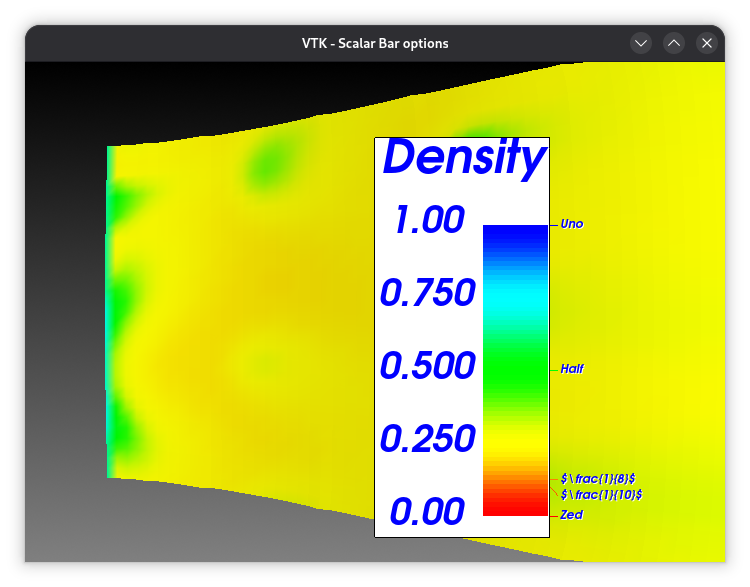
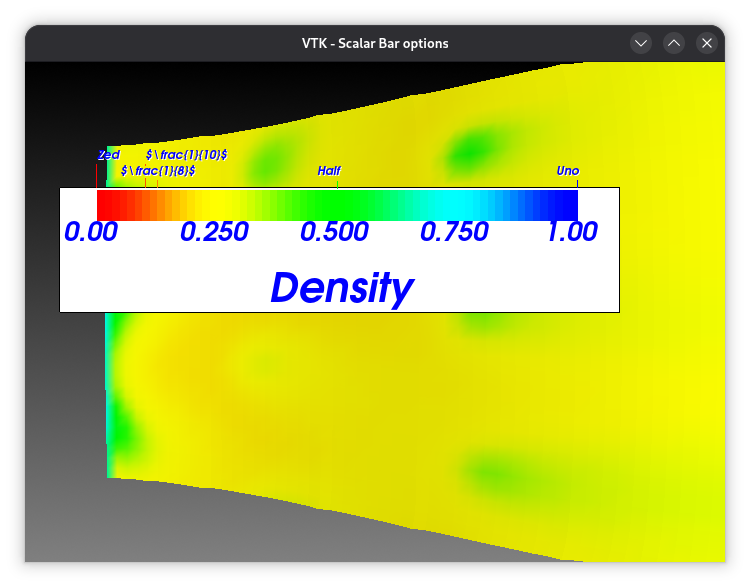
Scalar Bar Vertical Title Separation The
VerticalTitleSeparationproperty in a scalar bar controls the distance between the title of the scalar bar and the color bar itself when the title is oriented vertically. This property is now applied even for horizontal scalar bars, ensuring consistent spacing regardless of orientation.
Vertical Scalar Bar |
Horizontal Scalar Bar |
|---|---|
|
|
Build#
Add CMake Option for HDF5 Thread Safety You can now enable HDF5 thread safety in the build by setting the new
VTK_USE_HDF5_THREAD_SAFETYCMake option. This allows VTK to use HDF5 in multi-threaded environments, enabling you to load multiple HDF5 files concurrently.Add PLATFORM_TARGET argument for vtkModule CMake APIs The
vtk_module_buildfunction now supports aPLATFORM_TARGETkeyword argument. This allows you to specify a target that provides platform-specific compile and link flags. These flags will be automatically propagated to consumers of VTK modules, ensuring consistent builds across different platforms.
Core#
Add vtkPExecutableRunner
VTKnow has avtkPExecutableRunnerclass that handles command line execution in multi-process cases. AsvtkExecutableRunnerruns commands on every process, this class controls on which process the command will be executed.
DataModel#
Add an abstract vtkCartesianGrid A new abstract class,
vtkCartesianGrid, adds a layer of abstraction to bothvtkImageDataandvtkRectilinearGrid. It is now possible to use a common API for both classes. (Author notes)Introduce the implicit vtkStridedArray: a strided view on a buffer The
vtkStridedArrayis avtkImplicitArrayproviding a strided view on an existing memory buffer. If you work with a multi-dimensional buffer of data, you can create avtkStridedArrayto manipulate a single dimension (which can itself be a scalar or a vector) of this buffer through the classicalvtkDataArrayAPI. (Author notes)vtkCellArray: Support offsets/connectivity as vtkDataArray The
vtkCellArrayused to be able to support storing connectivity and offsets that are eithervtkTypedInt32ArrayorvtkTypedInt64Array. It now supports storing the connectivity and offsets as anyvtkDataArraysubclass usingvtkCellArray::SetData(vtkDataArray* offsets, vtkDataArray* conn). Additionally,vtkAffineArrayhas become a first-class citizen invtkCellArrayto support creating a cell array with cells of constant size without needing to store the offsets explicitly, thereby saving memory. (Author notes)vtkDataArray: Add GetMemorySpace and GetDeviceVoidPointer API
vtkDataArraynow includes two new methods:GetMemorySpace()andGetDeviceVoidPointer(). These methods provide enhanced support for device memory management, allowing users to query the memory space of the data array and obtain a device pointer for direct access, if available. Automatic tolerance invtkCellValidatorAn automatic per-polyhedron tolerance is now provided as an option to the validator. It will choose a tolerance that is a fraction of the shortest non-zero edge length to prevent unwanted coincident vertices.
Filters#
Add ONNX inference ONNX Inference is now available via
vtkONNXInference. This new filter allows inference of AI models using the ONNX framework in VTK. This filter is added in a new module dedicated to ONNX and AI-related computation. The filter takes as input a vector of parameters and outputs cell or point data of any dimension. It can also use the cell data or the point data as the input of the model. (Author notes)Add source: Lissajous point cloud The
vtkLissajousPointCloudalgorithm is a source that creates a poly-data object with vertex cells on or near a periodic, parameterized, three-dimensional curve.Add vtkPointsMatchingTransformFilter
VTKnow hasvtkPointsMatchingTransformFilter, a new way to transform avtkPointSetby specifying 4 pairs of points in space and deducing the uniquely defined affine transform.Create HyperTreeGridRedistribute filter A new filter for redistributing HyperTrees from a HTG has been created, so trees are balanced equally between partitions.
Introduce vtkRedistributeDataSetToSubCommFilter This new data distribution filter aggregates data onto specified MPI ranks for writing to disk or other processing tasks. To specify the ranks where data should be aggregated, you must provide an MPI sub-communicator configured for only the target MPI processes.
VTK can now segment a scalar field into discrete intervals VTK can now generate discrete segmentation labels from a continuous scalar field. The newly added filter
vtkThresholdScalarssegments the scalars through the definition of one or more[min,max,labelId)scalar intervals.
I/O#
Adding stream support to various readers
vtkResourceStreamcan now be encapsulated into astd::streambufusingvtkResourceStream::ToStreambuf(). Stream support has been added to:vtkSTLReader,vtkPTSReader,vtkHDFReader(prefer memory stream),vtkCityGMLReader(prefer memory stream),vtkOpenVDBReader,vtkDICOMImageReader,vtk3DSImporter, andvtkOBJImporter. (Author notes)Add support for cell array and point array with the same name in Conduit VTK now correctly converts a data object with two arrays that have the same name to a Conduit node. The two arrays (points and cells) are renamed to
arrayName_vertexandarrayName_elementin the Conduit node only when a name conflict occurs.Add support for LAS offsets in vtkPDALReader
vtkPDALReadercan now read X/Y/Z offset values from PDAL metadata. This improves handling of georeferenced LAS/LAZ files by applying the proper offset without manual configuration.New notation and precision support in vtkDelimitedTextWriter Added support for specifying numeric notation (e.g., scientific, fixed) and precision when writing floating-point data.
New USD exporter added
vtkUSDExporteris a new class that exports VTK scenes to Universal Scene Description (USD) files (.usd, .usda (ASCII), and .usdc (binary)). It is part of a newvtk::IOUSDmodule that depends on OpenUSD. (Author notes)Polyhedrons support in VTKHDF Polyhedron cells are specified as part of the VTKHDF specification, and
vtkHDFReadernow supports Polyhedron cells as part of the Unstructured Grid type, through new VTKHDF fields.vtkImageReader2 now supports reading vtkResourceStream
vtkImageReader2::Get/SetStreammethods have been added and implemented invtkPNGReader,vtkTGAReader,vtkJPEGReader,vtkHDRReader, andvtkBMPReader.vtkIOSSReader: Add GroupAlphabeticVectorFieldComponents
vtkIOSSReadercan now control whether to group alphabetic vector field components, such asvel_x,vel_y,vel_z, into a single vector field, such asvel, which was automatically done before.Setting for increased ASCII precision The Legacy and XML writers now provide a method named
SetPrecision()to specify the number of decimal digits of precision to use when writing floating-point data-arrays in ASCII format. The default is 11 (which matches the previous behavior and keeps file size low for medium-sized data) but it can now be adjusted to 17 (so that double-precision floating-point values are exactly preserved).
Interaction#
Add a new widget to handle a configurable number of lines
VTKnow has avtkMultiLineWidgetclass that handles a configurable number ofvtkLineWidget2instances. The representation of this class is avtkMultiLineRepresentation, which displays the corresponding number ofvtkLineRepresentation.Add behavior to clear one axis or all axes selection in vtkChartParallelCoordinates For parallel coordinates charts, data selection can now be interactively cleared:
Left-clicking without dragging on an axis clears the selected axis.
Left-clicking within the chart area outside of the axes area clears the entire chart selection.
Add missing selection mode behavior in parallel coordinates chart The parallel coordinates chart supports new keyboard shortcuts for different selection modes:
Press
Ctrlwhile selecting to add to the current selection.Press
Shiftwhile selecting to subtract from the current selection.Press
Ctrl+Shiftwhile selecting to toggle compared to the current selection. (Author notes)
Python#
Add numpy support for composite arrays You can now use VTK composite arrays with numpy functionality just like non-composite arrays. All numpy-related algorithms previously accessible via
algs(alias fornumpy_interface.algorithms) are now accessible directly with their numpy counterparts (e.g.,np.mean). Slicing is now also available. (Author notes)Add Python Free threading support VTK’s Python wrappers now support Python’s free-threading mode (PEP 703), available since Python 3.13+.
Rendering#
Add composite data texturing
vtkCompositePolyDataMappercan now handle textures for composite data. Textures can be assigned with a block flat index, thus texturing each block differently.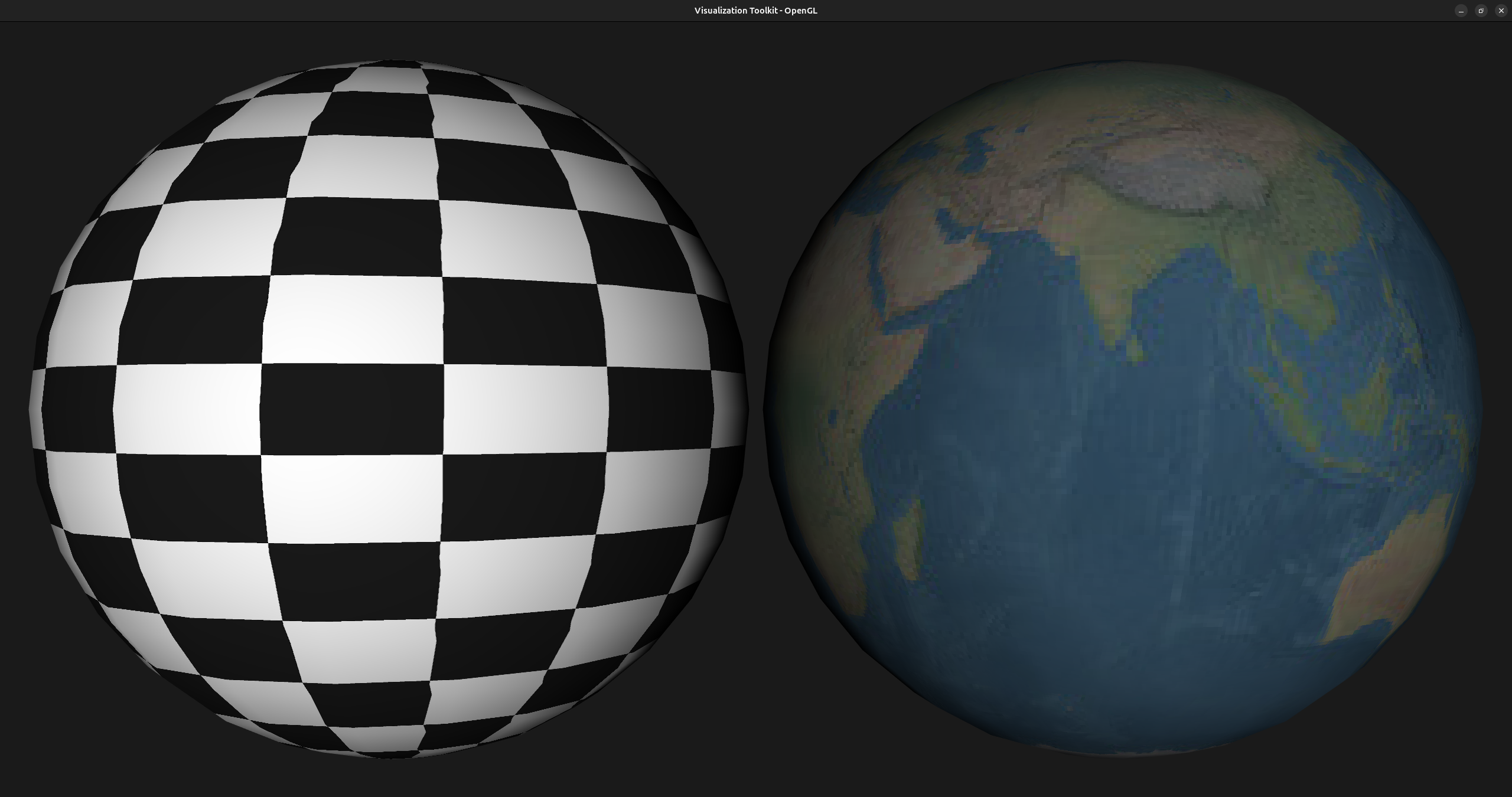
Add rotation parameters to OpenGL skybox OpenGL Skybox now supports rotations, which are also applied to the image-based lighting in the polydata mapper. A rotation matrix
EnvironmentRotationMatrixis now available in thevtkRenderer.Add support for coloring with LUT in vtkOpenGLSurfaceProbeVolumeMapper Allows
vtkOpenGLSurfaceProbeVolumeMapperto use a lookup table for coloring. If a lookup table is provided, a texture map is used for coloring in order to map a 1-component image through the lookup table when probing.Add texturing support in WebGPU VTK’s WebGPU backend now supports texture mapping for 3D models. You can turn on
InterpolateScalarsBeforeMappingon the polydata mapper or apply a texture to the actor.Add Wayland support for the vtkEGLRenderWindow
vtkEGLRenderWindowsupports native Wayland as a backend, which will be able to perform onscreen and offscreen rendering. To use it, you need to set the new optionVTK_USE_WAYLAND_OPENGLtoON.Extend vtkProperty with a new line join setting You can now set the kind of join geometry to use between contiguous line segments of a polyline with the
vtkProperty::SetLineJoin(LineJoinType)method. The possible values areRoundCapRoundJoin,MiterJoin, andNoJoin.
WebAssembly#
Add JavaScript wrappers with Emscripten Use the automated wrapping infrastructure of the
VTK::WrappingToolsmodule to generate JavaScript bindings of the VTK C++ classes by enabling theVTK_WRAP_JAVASCRIPTCMake option. (Author notes)Add serialization support for custom modules VTK now provides a new CMake function
vtk_module_add_serdes_wasm_package. You can use it to enable (de)serialization for external VTK modules in WASM.Add WebAssembly interface for standalone applications You can now develop remote WASM or standalone WASM applications using the
vtkWebAssembly.wasmbinary. TheVTK::WebAssemblyandVTK::WebAssemblyAsyncnow build avtkWebAssembly[Async].wasmand associated.mjsfile that providevtkRemoteSessionandvtkStandaloneSessionJavaScript classes.Limit number of WASM threads Enable the possibility to limit the number of WASM threads available for the SMP STDThread backend. A parameter,
VTK_WEBASSEMBLY_SMP_THREAD_POOL_SIZE, is introduced.
Changes#
Build#
Compilers: Increase Minimum Microsoft Visual Studio Version to 2019 Due to the addition of the
scnliblibrary and an update in theexpatlibrary, the minimum supported version of Microsoft Visual Studio (MSVC) for building VTK has been increased to MSVC 2019.VTK_LEGACY_REMOVE is now ON by default In anticipation of the deprecation of
VTK_LEGACY_REMOVEand its replacement byVTK_DEPRECATED_IN_*,VTK_LEGACY_REMOVEis nowONby default.
Core#
Add functions to import/export object manager state from/to byte arrays VTK’s
vtkObjectManagerclass now includes methods to import (ImportFromBytes) and export (ExportToBytes) its state using byte arrays.Remove
from core header file Including<iostream>in a header induces global constructors into every downstream translation unit. It has been removed from thevtkIOStreamheader.Replace unsafe C from/to string functions VTK has been using a set of either unsafe or slow C/C++ functions to convert numbers to strings or vice versa (e.g.,
atof,sprintf,sscanf). These have been replaced by safer/faster alternatives provided byscnlib,fmt, andfast_floatlibraries and exposed through thevtk::namespace. (Author notes)Unify library lookup APIs in vtkResourceFileLocator VTK now uses a single method to determine which library provides a given function:
vtkResourceFileLocator::GetLibraryPathForAddress(const void* ptr). This replaces the previous symbol-based functions on Unix and Windows, which are now deprecated.vtkmAlgorithm: A Wrapper for all VTK-m Algorithms The
vtkmAlgorithmclass serves as a wrapper for all VTK-m algorithms. As of now, it only exposes theForceVTKmflag.
DataModel#
Arrays have been added and deprecated Many concrete specializations of
vtkAffineArray,vtkCompositeArray,vtkConstantArray, andvtkIndexedArrayhave been deprecated in favor of new fixed-size specializations (e.g.,vtkAffineTypeFloat32Array). (Author notes)Deprecated vtkStructuredData Types All
vtkStructuredDatatypes (e.g.,VTK_XY_PLANE) have been deprecated and should be replaced by thevtkStructuredData::vtkStructuredDataTypesenum instead (e.g.,vtkStructuredData::VTK_STRUCTURED_XY_PLANE).Refactor of the AMR data model The AMR data model has been refactored for future proofing.
vtkUniformGridAMRnow inherits fromvtkPartitionedDataSetCollectioninstead ofvtkCompositeDataSet. Each AMR level is now stored as avtkPartitionedDataSet.vtkAMRInformationhas been separated intovtkAMRMetaDataandvtkOverlappingAMRMetaData. (Author notes)Refactor vtkHyperTree class to simplify it
vtkHyperTreeis now an instantiable class. All the implementations ofvtkCompactHyperTreehave been moved tovtkHyperTree.
Filters#
Querying and resetting arrays to process and specify array components
vtkAlgorithmnow providesGetNumberOfInputArraySpecifications()andResetInputArraySpecifications(). Additionally,vtkAlgorithm::SetInputArrayToProcess()now supports specifying array components or norms (L1, L2, L∞) to process directly. A new methodGetInputArrayComponent()is available to determine if specific components/norms are requested. (Author notes)Statistics algorithms refactored
vtkStatisticsAlgorithmand its subclasses have been refactored to produce instances of a new data object (vtkStatisticalModel) for models rather than avtkMultiBlockDataSet. This is a breaking change. New filtersvtkGenerateStatistics,vtkVisualStatistics,vtkSumTables, andvtkExtractStatisticalModelTableshave been added. (Author notes)
I/O#
Rework vtkImporter API
vtkImporter::GetTemporalInformationhas been reworked and now provides a simpler API that does not require framerate.Remove variables related to Scalar and Vector data from public API in vtkFLUENTCFFReader
ScalarDataChunkandVectorDataChunkstructs have been refactored into a single generic structDataChunk, which is private.vtkConduitArrayUtilities: Remove unsafe force_signed flag usage The
force_signedflag was used duringvtkCellArraycreation in Conduit to VTK conversion. Now thatvtkCellArraysupports anyvtkDataArraytype, theforce_signedflag is no longer needed and has been removed.vtkIOSSReader: Replace SetReadGlobalFields with vtkDataArraySelection GlobalFieldSelection()*
SetReadGlobalFieldshas been deprecated in favor of a more flexible approach usingvtkDataArraySelection* GlobalFieldSelection().
Rendering#
Make vtkUniforms a non-abstract class The
vtkUniformsclass is now not an abstract class. This is required for compatibility with the new WebGPU backend.vtkAxisActor2D no longer has a limit on the number of labels Labels and actors are now dynamically allocated. Therefore,
VTK_MAX_LABELS = 25has been deprecated and is not used anymore.
WebAssembly#
Enable exception support for WebAssembly builds The
VTK_WEBASSEMBLY_EXCEPTIONSoption is now removed, and the libraries are now compiled and linked with-fwasm-exceptions.
Fixes/improvements#
Accelerators#
Fix IsHipDevicePointer compile error and update memory type checks A compile error caused by referencing a non-existent
TYPE_ATTRmember inhipPointerAttribute_twas fixed. The code now uses the correcttypemember for HIP 6 and later, and the device pointer check includeshipMemoryTypeManaged. (Author notes)
Annotation#
vtkPolarAxesActor improvements You can now use
vtkAxisActor::UseText3Dmode from thevtkPolarAxesActor. In this mode, the text is a rasterized image in 3D space.
Charts#
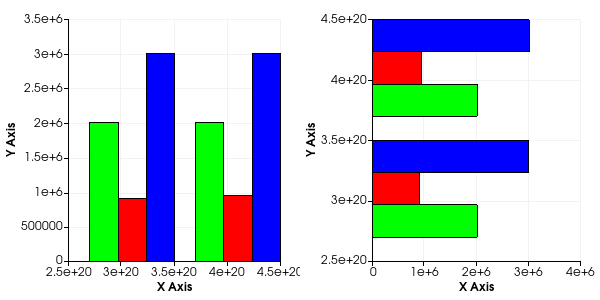
vtkPlotBar: Account for shift scale in bar width calculation The bar width calculation in
vtkChartXY::CalculateBarPlotsnow correctly considers the shift and scale transformations applied to the bar’s input data, ensuring bar widths are rendered correctly.
Before |
After |
|---|---|
|
|
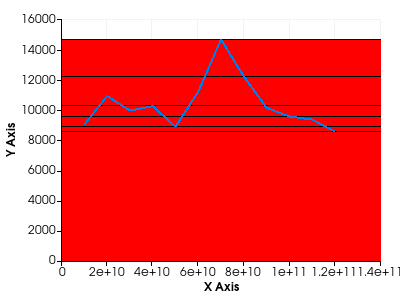
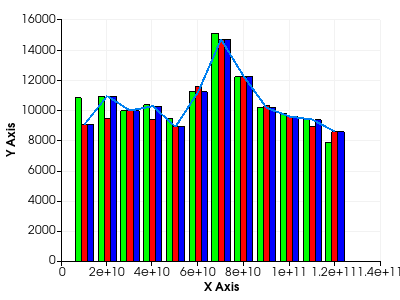
Core#
Faster vtkDataAssembly node traversal Unify implementation of
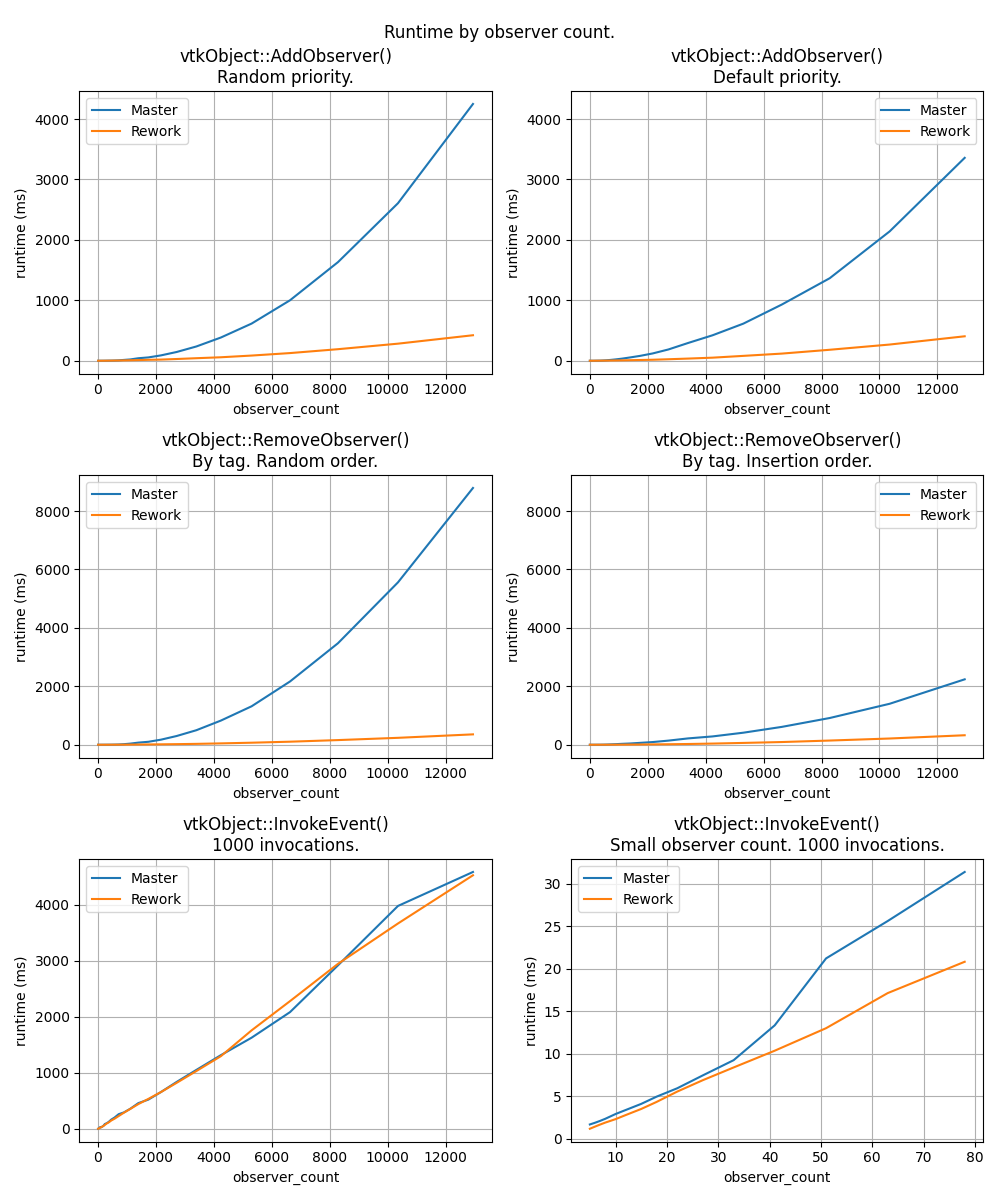
IsNodeNameReservedand add short-circuiting logic to optimize for typical usage. Improves performance ofGetChildand dependent methods by about 50%.Performance: Faster observer operations in vtkObject
vtkObjectnow stores observers in astd::map.AddObserverandRemoveObserverboth use a binary search, providing O(log n) runtime per operation. (Author notes)
vtkAbstractArray: Replace most instances of GetVoidPointer Approximately 75% of
GetVoidPointer()usages have been removed to reduce unnecessary data duplication and copying overhead. (Author notes)vtkArrayDispatch: Dispatch known Arrays with O(1) complexity The
vtkArrayDispatchmechanism has been optimized to O(1) complexity, regardless of the number of given arrays, by adding compile-time known tags to each VTK array.vtkDataArrayPrivate: Improve DoCompute(Scalar/Vector)Range Performance
DoComputeScalarRangeandDoComputeVectorRangehave been optimized to enhance performance by about 2x.vtkFieldData performance Copying
vtkFieldDatastructures withDeepCopyandPassDatais now faster (up to 70x/180x speedup observed) by assuming uniqueness in the source.vtkMaybeUnused macro removal The
vtkMaybeUnusedmacro was not functional and has been removed. Use the[[maybe_unused]]attribute instead.
DataModel#
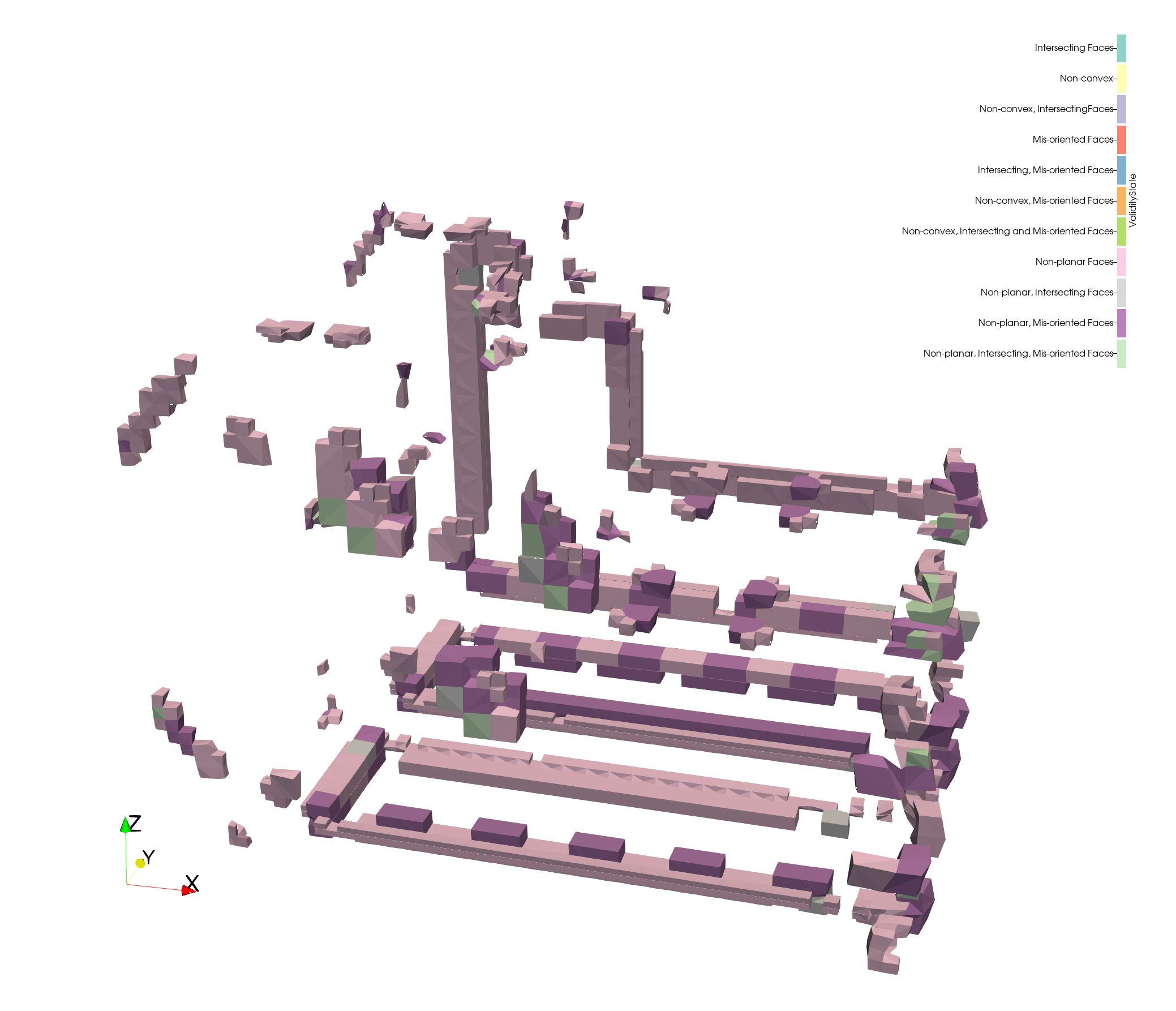
Cell status enumeration, vtkPolygon, and vtkPolyhedron The enumeration of defects detected by
vtkCellValidatorhas been expanded and moved tovtkCellStatus.h.vtkPolygonandvtkPolyhedronnow report additional defects.
Fix vtkQuadricDecimation point data attributes Fixed regression where PointData attributes were incorrectly computed.
Improve vtkBlockIdScalars
vtkBlockIdScalarsnow supports anyvtkDataObjectTree, which includesvtkPartitionedDataSetCollection. It also supports iterating into a composite hierarchy.vtkArrayCalculator: Enable vector definition of arbitrary size
vtkArrayCalculatornow supports user-defined vectors of arbitrary size using the{x, y, z, ...}syntax.vtkDataSet: GetCellTypes updates
vtkDataSet::GetCellTypeshas been deprecated in favor ofGetDistinctCellTypes.vtkUnstructuredGridnow usesvtkDataArrayfor cell types to allow forvtkConstantArray<unsigned char>.vtkmDataArray: Fix thread-safety issues Fixed thread-safety issues in
GetTuple/SetTupleby adding a mutex to protect the internal array handle swap.Fixed Template Array Serialization VTK now correctly serializes template arrays. This fix ensures that template array types are properly handled during serialization, improving compatibility between Python and WebAssembly (WASM) builds.
Filters#
Correct thresholding behavior in vtkThresholdPoints
vtkThresholdPointsnow uses the same rules asvtkThresholdfor both lower and upper bounds.Fix cubic interpolation for small image dimensions The cubic interpolation mode of
vtkImageInterpolatorno longer gives incorrect results for input images with small dimensions.Fix distributed HTG ghost cells issues Ghost array is now correctly added to distributed HTG when ghost cells are requested, and HTG metadata is properly exchanged.
Fix interpolate scalars before mapping in surface LIC mappers A scalar mapping bug has been fixed in the surface LIC mappers. Interpolation now correctly occurs before mapping the scalars to colors when the flag is enabled.
Fix retrieval of the closest point in vtkStaticPointLocator The function
IntersectWithLineofvtkStaticPointLocatornow always retrieves the closest point.Fix vtkCleanPolyData large tolerance
vtkCleanPolyDatanow supports large tolerance. Mesh stays watertight in case of large tolerance.Improve the clipping performance for polyhedrons Clipping operations on unstructured grids composed mostly of polyhedron cells are now significantly faster (up to 300x).
Large tolerance in vtkCleanPolyData
vtkCleanPolyDatanow supports large tolerance. Mesh stays watertight and cells no longer disappear arbitrarily.vtkAxisAlignedReflectionFilter: Improve Assembly Construction for PDC
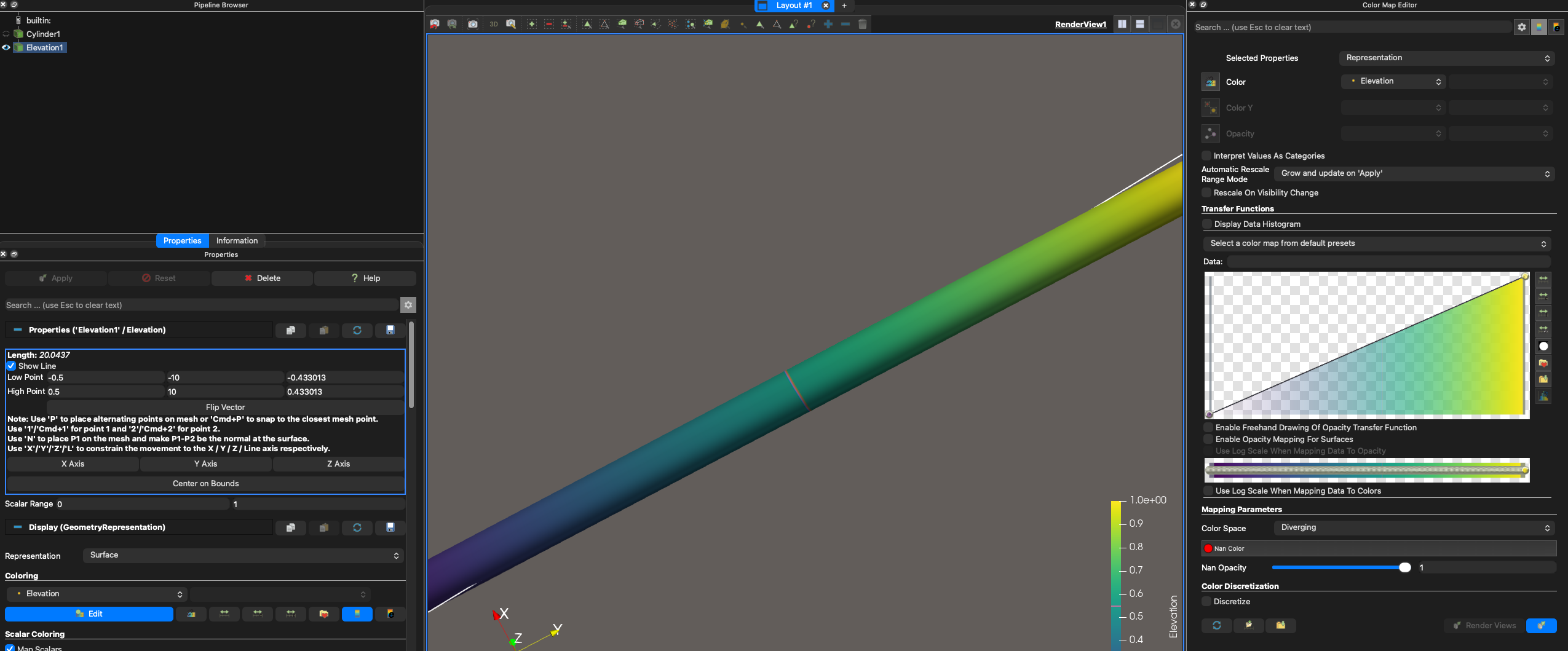
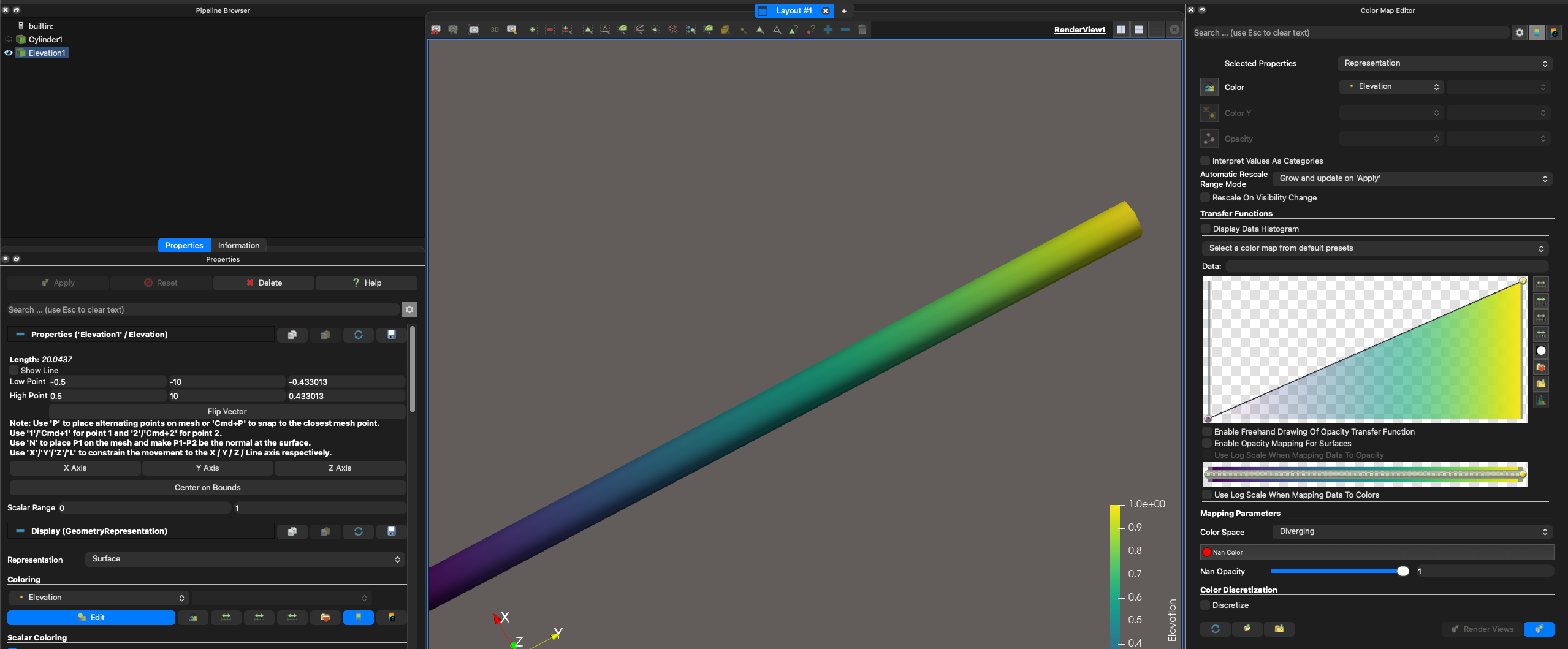
vtkAxisAlignedReflectionFilternow constructs the outputvtkDataAssemblyby reflecting the input assembly, preserving the hierarchical structure.vtkColorTransferFunction: Consider Hue as circular for diverging interpolation
vtkColorTransferFunctionhas been updated to consider that Hue may be circular when performing diverging interpolation.
Before |
After |
|---|---|
|
|
vtkMeshQuality: Add non-linear cells support The
vtkMeshQualityfilter has been updated to exposeVerdictmetrics for non-linear cells (e.g.,vtkQuadraticTriangle,vtkQuadraticHexahedron).vtkRedistributeDataSetFilter: fix missing cells in ASSIGN_TO_ONE_REGION mode Concave cells that lie on the boundary of multiple partitions could be deleted in this mode; this is now fixed.
vtkSurfaceNets3D: Fix Consistent Normal Orientation
vtkSurfaceNets3Dnow generates meshes with consistent normal orientations.vtkTableBasedClipDataSet: Add GenerateClipPointType
vtkTableBasedClipDataSetnow includes a new option calledGenerateClipPointTypethat allows users to specify whether to generate a point array specifying the type of each point (input, edge, or centroid).vtkTableBasedClipDataSet: Fix Clipping Duplicating Points
vtkTableBasedClipDataSetno longer duplicates points when processing cells that are not supported by it.
I/O#
Fix wrong default value of vtkXMLUniformGridAMRReader::MaximumLevelsToReadByDefault Default value is now 0 (infinite) as documented, instead of 1.
HyperTreeGridXMLReader: support Coordinates Bounding box for V2 files Add support for
CoordinatesBoundingBoxinvtkXMLHyperTreeGridReaderfor files with major version 2.Improve glTF camera focal point Introduced a
vtkGLTFImporter::GuessCamerasFocalPoints()called at the end of the import to assign a less arbitrary focal point based on the imported actors.Improve Importers animation API
vtkImporter::GetTemporalInformationhas been reworked and now provides a simpler API.Only keep first array if duplicated names in XML readers When reading a dataset with multiple arrays with the same name, a warning is displayed and only the first one is kept.
Support multimesh protocol in vtkDataObjectToConduit Add serialization support for composite structures in
vtkDataObjectToConduit, using the multimesh protocol.vtkDataObjectToConduit improvements
vtkDataObjectToConduitimproves support for mixed-shape polydata meshes, polygons, triangle strips, poly lines, and poly vertex cells.vtkIOSSReader: Change Catalyst Conduit channel name
vtkIOSSReadernow supports changing the Catalyst Conduit channel name when reading from IOSS catalyst databases.vtkIOSSReader: Distributed read of a single file using netCDF parallel The
vtkIOSSReadernow supports reading a single IOSS file in parallel using the netCDF parallel I/O capabilities.vtkIOSSWriter: Write tensor arrays as tensors
vtkIOSSWriternow writes tensor arrays as tensors instead of separate scalar components.vtkMultiProcessStream: Support for vtkDataArray and vtkStringArray
vtkMultiProcessStreamhas been updated to supportvtkDataArrayandvtkStringArray.
Interaction#
Fix Bi-dimensional widget 2D representation for any view plane The
vtkBiDimensionalRepresentation2Dhas been generalized to handle view planes other than the XY plane in world coordinates.Fix Cocoa timer crash Fixed a macOS crash when timers restart after interactor destruction (
vtkCocoaRenderWindowInteractor).Fix update of properties in vtkLineRepresentation and add setters The
vtkPropertyof elements ofvtkLineRepresentationis now correctly updated.Improve box widget/representation The box widget can now be rotated along a single axis by holding the x, y, or z key. Scaling interaction has also been improved.
Python#
Python object property setter argument types The setter method called when setting an object property in Python is now the same regardless of whether a tuple or a list is used. If a multi-argument setter exists, it is used.
VTK SDK as wheels are now available on the wheel-sdks repository The VTK wheel SDK is now packaged directly as Python wheels (.whl).
Java#
Fixed several build errors in VTK module-generated Java wrappings.
Restored Java Maven package generation and upload mechanism to Kitware’s Maven repository located at https://github.com/orgs/Kitware/packages.
Added Java test jobs that run in VTK’s CI.
Rendering#
ANARI Renderer Introspection The
vtkAnariRendererclass now allows users to introspect and query the parameters supported by the chosen ANARI rendering backend.Dynamic X11 Function Loading in VTK VTK now supports dynamic loading of X11 functions through the new
VTK::x11module. You no longer need a hard X11 dependency.Fix reslice gap Fixed a tolerance issue in
vtkImageReslicethat could cause black slices in rare streaming situations.Improve JOGL Integration (JogAmp v2.6.0) Improved integration with JOGL/JogAmp v2.6.0. Fixed
vtkGenericOpenGLRenderWindow::OpenGLInit()and ensured seamless OpenGL usage between JOGL and VTK.Improved vtkDataSetMapper performance The newer
vtkGeometryFilterincludes many speedups and is now being used invtkDataSetMapperinstead of the oldervtkDataSetSurfaceFilter.Support point size in vtkGlyph3DMapper OpenGL backend in WASM Fixed a bug where glyphs rendered with point representation appeared very small on WASM/GLES3.
Fix incorrect connectivity crash VTK no longer crashes when it renders a
vtkPolyDatawith invalid index in the connectivity array of the cells.
WebAssembly#
Fix wrapping tools suffix for WASM The wrapping tools now use a
.commonjssuffix, preventing runtime errors when running with Node.js projects that use"type": "module".
Deprecations/Removals#
Deprecated Members Removal: Removed
vtkHyperTreeGridThreshold::JustCreateNewMaskandvtkTemporalAlgorithm::RunBackward.Deprecated vtkCollection API with bad spelling: Deprecated
IndexOfFirstOccurencein favor ofIndexOfFirstOccurrence.Deprecate unused vtkHyperTree(Grid) methods and options:
vtkHyperTree::Freeze,vtkHyperTreeGrid::Squeeze, and related members.Deprecate vtkUniformGrid methods:
vtkUniformGridis now an empty shell.Deprecate vtkmDataSet: Deprecated since all
vtkmDataArraycan now be stored inside a subclass ofvtkDataSetas avtkDataArray.HyperTreeGridScales Getters deprecation: Deprecated
GetScales[X/Y/Z], replaced byComputeScale[X/Y/Z].vtk::DataArrayValueRange: Deprecated
data()method in favor ofbegin()/end().
Updates#
h5Part: Migrate to h5hut to 2.0.0:
VTK::h5parthas been replaced byVTK::h5hut.hdf5: Updated to 1.14.6.
Ioss: Updated to seacas v2025-08-28.
netCDF: Updated to 4.9.3.
Remove double-conversion: Removed in favor of using
fmt.verdict: Updated to 1.4.4.
Viskores: Updated to 1.1.0.
fmt: Updated to 12.1.0.(Author notes)
Patch Releases#
The following changes have been made since v9.6.0
v9.6.1#
Multiple scattering approximation for image-based lighting
VTK’s PBR renderer now applies a multiple scattering energy-compensation approximation when using image-based lighting (IBL). Previously, high-roughness metallic surfaces appeared artificially dark because single-scattering models lose energy at each bounce. The new approximation redistributes that lost energy, keeping surfaces physically plausible across the full roughness range. (Author notes)
Fix vtkConstantArray and vtkAffineArray conversion to Viskores
The Viskores data converters now properly convert
vtkConstantArraytoviskores::cont::ArrayHandleConstantandvtkAffineArrayto eitherviskores::cont::ArrayHandleIndexorviskores::cont::ArrayHandleCounting. Previously, dataset fields using these array types caused the entire conversion to fail. Additionally, encountering an unknown array type now issues a warning and continues conversion rather than aborting, so only the affected fields are dropped. (Author notes)Control focal point reset behavior in vtkCameraOrientationWidget
vtkCameraOrientationWidgetpreviously calledResetCamera()unconditionally during animation frames and selection actions, recalculating the focal point. This behavior is now controlled by the newShouldResetCameraflag. The default value istrueto preserve existing behavior, but setting it tofalseprevents the camera from resetting its focal point during interactions. (Author notes)QVTKRenderWindowInteractor: Add PageUp and PageDown key mappings
QVTKRenderWindowInteractornow maps thePageUpandPageDownkeys to their corresponding VTK keysyms"Prior"and"Next". Previously, these mappings were only available through C++. (Author notes)Fix EGL render window initialization warning
Unused OpenGL point sprite enabling code has been removed from the EGL render window initialization. Point sprites are available by default in core OpenGL profiles and do not require explicit enabling, eliminating a harmless warning during window setup on some systems. (Author notes)
Fix inconsistent batch rendering for overlapped images
Fixed a bug when rendering unaligned sliced overlapped images or AMR data that could produce inconsistent slices between multiple render calls. (Author notes)
Fix OpenGL version check emitting misleading warnings
OpenGL version compatibility warnings now only appear when the OpenGL version is actually below 3.2, rather than whenever initialization fails for any reason. This resolves misleading version warnings caused by a regression introduced when GLAD was integrated for OpenGL function loading. (Author notes)
Fix vtkFramebufferPass GL_INVALID_OPERATION error on GLES 3.0
vtkFramebufferPasscan now be used in WebGL2 (GLES 3.0) withoutGL_INVALID_OPERATIONerrors. It automatically detects when blitting to a multisampled draw framebuffer and uses an alternative copy method. (Author notes)Fix vtkMatplotlibMathTextUtilities null pointer crash on big-endian
vtkMatplotlibMathTextUtilities::RenderOneCell()now safely handles a null scalar pointer in the generated image object, which could occur on big-endian architectures (e.g., s390x), causing segfaults. (Author notes)Fix vtkSSAAPass null program error when changing renderers
vtkSSAAPasscan now be safely reused across renderer changes without encountering null program errors. (Author notes)
v9.6.2#
Improved data array serialization performance
Data array serialization now exits early when the array’s modification time (MTime) is older than the MTime recorded in the serialization state, avoiding redundant work.
vtkObjectManager::UpdateStatesFromObjects()runs faster when many arrays in your scene are unchanged.Fix crash when vtkConvertToPointCloud has null points in input
Previously, when
vtkConvertToPointCloudhad an inputvtkPointSetwith a nullvtkPoints, it would crash with a seg fault. The filter now first checks whether the points object exists before attempting to copy it. This can happen fairly easily in MPI parallelism when some ranks receive no data.Fix vtkHyperTreeGridEvaluateCoarse performance
Fixed a multithreaded
vtkHyperTreeGridEvaluateCoarseexecution race condition, and improved performance for some datasets by multi-threading only at tree level and not below.Fix vtkDICOMImageReader incorrectly reading scientific notation
A regression in VTK 9.6.0 caused metadata stored in scientific notation to be read incorrectly or, when built in debug mode, to cause a failed assertion and a crash. This issue is now fixed.
Reduce CPU usage in Win32 event loop
VTK no longer busy-waits in the Win32 event loop, significantly reducing CPU usage when the application is idle. The event loop now uses
WaitMessage()to sleep when no events are pending, instead of continuously spinning the CPU.Handle floating-point error when using Below Range/Above Range colors in vtkMapper
Datasets with point or cell data arrays at the Below Range or Above Range colors could be color mapped incorrectly due to floating-point errors when mapping data values to texture coordinates. The fix explicitly checks the computed texture coordinates and adjusts them by epsilon so they remain on the correct side of the texture range boundary.
Fix vtkSSAAPass with multiple viewports
Fixed
vtkSSAAPassnot rendering in all viewports except bottom-left. The issue was resolved by respecting the viewport’s origin when copying the result to the output framebuffer.