
numpy.random.Generator.logistic#
方法
- random.Generator.logistic(loc=0.0, scale=1.0, size=None)#
Draw samples from a logistic distribution.
Samples are drawn from a logistic distribution with specified parameters, loc (location or mean, also median), and scale (>0).
- 參數:
- locfloat or array_like of floats, optional
Parameter of the distribution. Default is 0.
- scalefloat or array_like of floats, optional
Parameter of the distribution. Must be non-negative. Default is 1.
- sizeint or tuple of ints, optional
Output shape. If the given shape is, e.g.,
(m, n, k), thenm * n * ksamples are drawn. If size isNone(default), a single value is returned iflocandscaleare both scalars. Otherwise,np.broadcast(loc, scale).sizesamples are drawn.
- 回傳值:
- outndarray or scalar
Drawn samples from the parameterized logistic distribution.
也參考
scipy.stats.logisticprobability density function, distribution or cumulative density function, etc.
Notes
The probability density for the Logistic distribution is
\[P(x) = \frac{e^{-(x-\mu)/s}}{s(1+e^{-(x-\mu)/s})^2},\]where \(\mu\) = location and \(s\) = scale.
The Logistic distribution is used in Extreme Value problems where it can act as a mixture of Gumbel distributions, in Epidemiology, and by the World Chess Federation (FIDE) where it is used in the Elo ranking system, assuming the performance of each player is a logistically distributed random variable.
References
[1]Reiss, R.-D. and Thomas M. (2001), 「Statistical Analysis of Extreme Values, from Insurance, Finance, Hydrology and Other Fields,」 Birkhauser Verlag, Basel, pp 132-133.
[2]Weisstein, Eric W. 「Logistic Distribution.」 From MathWorld–A Wolfram Web Resource. https://mathworld.wolfram.com/LogisticDistribution.html
[3]Wikipedia, 「Logistic-distribution」, https://en.wikipedia.org/wiki/Logistic_distribution
範例
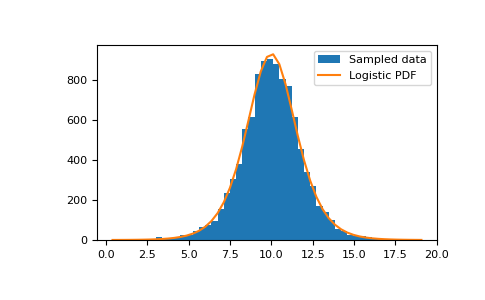
Draw samples from the distribution:
>>> loc, scale = 10, 1
>>> rng = np.random.default_rng()
>>> s = rng.logistic(loc, scale, 10000)
>>> import matplotlib.pyplot as plt
>>> count, bins, _ = plt.hist(s, bins=50, label='Sampled data')
# plot sampled data against the exact distribution
>>> def logistic(x, loc, scale):
...     return np.exp((loc-x)/scale)/(scale*(1+np.exp((loc-x)/scale))**2)
>>> logistic_values  = logistic(bins, loc, scale)
>>> bin_spacing = np.mean(np.diff(bins))
>>> plt.plot(bins, logistic_values  * bin_spacing * s.size, label='Logistic PDF')
>>> plt.legend()
>>> plt.show()